Compare FM-200, Novec 1230, and Inergen clean agent fire suppression systems. Learn the advantages, limitations, and ideal applications for each solution.
Facilities such as data centers, healthcare campuses, telecommunications hubs, control rooms, and other mission-critical environments often require fire protection that will not damage sensitive equipment. Clean agent suppression systems extinguish fires without leaving residue or exposing critical assets to water damage.
For facility managers evaluating options, the conversation often comes down to three solutions: FM-200, Novec 1230, and Inergen. While all three can effectively suppress fires, they operate differently and are better suited for certain applications.
What Is a Clean Agent Fire Suppression System?
A clean agent system uses a gaseous extinguishing agent to suppress fire without damaging equipment or leaving behind residue.
According to NFPA 2001: Standard on Clean Agent Fire Extinguishing Systems, clean agent systems are designed to extinguish fires while remaining safe for occupied spaces when properly engineered, installed, and maintained.
Most clean agents extinguish fires by absorbing heat or reducing oxygen levels within the protected space. The right fire suppression solution depends on the facility, occupancy, equipment value, and operational requirements.
FM-200: Fast Fire Suppression with a Proven Track Record
FM-200 has been one of the most widely used clean agent suppression systems for decades.
The system uses HFC-227ea, a gaseous agent that suppresses fire primarily by absorbing heat. When discharged, FM-200 rapidly fills the protected space and extinguishes fires within seconds.
Advantages of FM-200
- Rapid fire suppression
- No residue after discharge
- Safe for occupied spaces when properly designed
- Proven performance history
- Smaller storage footprint than inert gas systems
Considerations
FM-200 remains highly effective but faces increasing environmental scrutiny due to its global warming potential, leading some organizations to evaluate alternative clean agents.
Like all clean agent systems, FM-200 installations must comply with NFPA 2001 requirements for agent concentration, room integrity, testing, and maintenance.
FM-200 is commonly used in:
- Data centers
- Telecommunications facilities
- Financial institutions
- Healthcare technology rooms
- Control centers
Novec 1230: Environmental Performance and Asset Protection
Novec 1230 became a popular alternative for organizations seeking a lower environmental impact than traditional HFC-based suppression systems.
Using FK-5-1-12 fluid, the system suppresses fires by absorbing heat while providing many of the same operational benefits as FM-200.
Advantages of Novec 1230
- Extremely low global warming potential
- No ozone depletion potential
- Rapid suppression capabilities
- Safe for occupied spaces
- No residue after discharge
Considerations
Many facility managers still refer to “Novec 1230,” but since 3M discontinued production of PFAS-related products, organizations evaluating these systems today are often considering equivalent FK-5-1-12 agents from other manufacturers.
NFPA 2001 requires enclosure integrity and concentration testing to help ensure the agent remains within the protected space long enough to suppress a fire effectively.
Novec-style systems are frequently installed in:
- Healthcare facilities
- Museums
- Archives
- Government facilities
- Mission-critical technology environments
Inergen: An Inert Gas Alternative
Unlike FM-200 and Novec 1230, Inergen is an inert gas system that consists of naturally occurring gases, typically nitrogen, argon, and carbon dioxide. Rather than absorbing heat, it suppresses fire by reducing oxygen levels to a level that stops combustion while remaining safe for occupants when properly designed.
Advantages of Inergen
- No synthetic chemicals
- No ozone depletion potential
- No global warming potential
- Long-term agent availability
- Safe for occupied spaces
- Minimal environmental concerns
Considerations
Because Inergen is stored as compressed gas, it generally requires larger storage cylinders than FM-200 or FK-5-1-12 systems. This additional space requirement can be a challenge in facilities with limited equipment room capacity.
NFPA 2001 includes specific requirements for design concentrations and occupant safety considerations when using inert gas systems.
Inergen is often selected for:
- Large data centers

- Utility infrastructure
- Government facilities
- Critical manufacturing operations
- Long-term archival storage
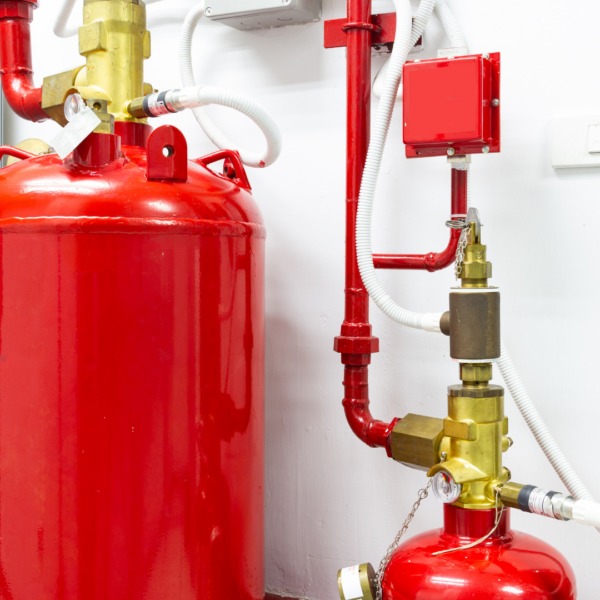
Clean Agent Fire Suppression Comparison
When performing a clean agent fire suppression comparison, the best system depends largely on what you are protecting.
- FM-200 is often chosen for its proven performance, rapid suppression, and compact storage requirements.
- Novec 1230 and other FK-5-1-12 agents are popular among organizations that prioritize environmental considerations and the protection of sensitive assets.
- Inergen appeals to facilities seeking an environmentally neutral solution with long-term agent availability, provided adequate storage space is available.
Which System Is Right for Your Facility?
There is no universal winner in the FM-200 vs Novec 1230 vs Inergen discussion.
The right system depends on the facility’s occupancy, asset value, environmental objectives, available space, and operational requirements. What works well for a healthcare facility or data center may not be the best choice for a manufacturing plant or utility facility.
A thorough hazard assessment and system evaluation can help determine which clean agent offers the right balance of protection, compliance, and long-term value.
Protect Critical Assets with the Right Suppression System
Choosing a clean agent system is about more than selecting a fire suppression technology. It is about protecting the systems, equipment, and operations your organization depends on every day.
Contact us today if you are evaluating options and need help with a clean agent fire suppression comparison. DynaFire can assess your facility, explain the advantages of each system, and recommend a solution designed around your operational and fire protection requirements.